.png)
From open work order to sent invoice, one workflow, one view.
Talk through your needs with us →.svg)
Technicians open a work order, log time, add parts, and close it out from wherever the work is happening. When it closes, labour, parts, and costs are already documented.
Manage work orders from the shop, the field, or the office.
Parts, labour, and costs tied to every RO automatically.
Service Board shows arrivals, progress, and what is next.
Each unit follows its own schedule based on mileage, engine hours, or calendar. Your team sees what is coming up and what is overdue before it becomes a conversation.
Mileage, hours, or calendar intervals. Each unit follows its own schedule based on how it runs.
Automated reminders surface upcoming and overdue PMs so nothing slips through the cracks.
Standardised PM inspection forms your technicians complete and sign digitally. Records stay with the unit.
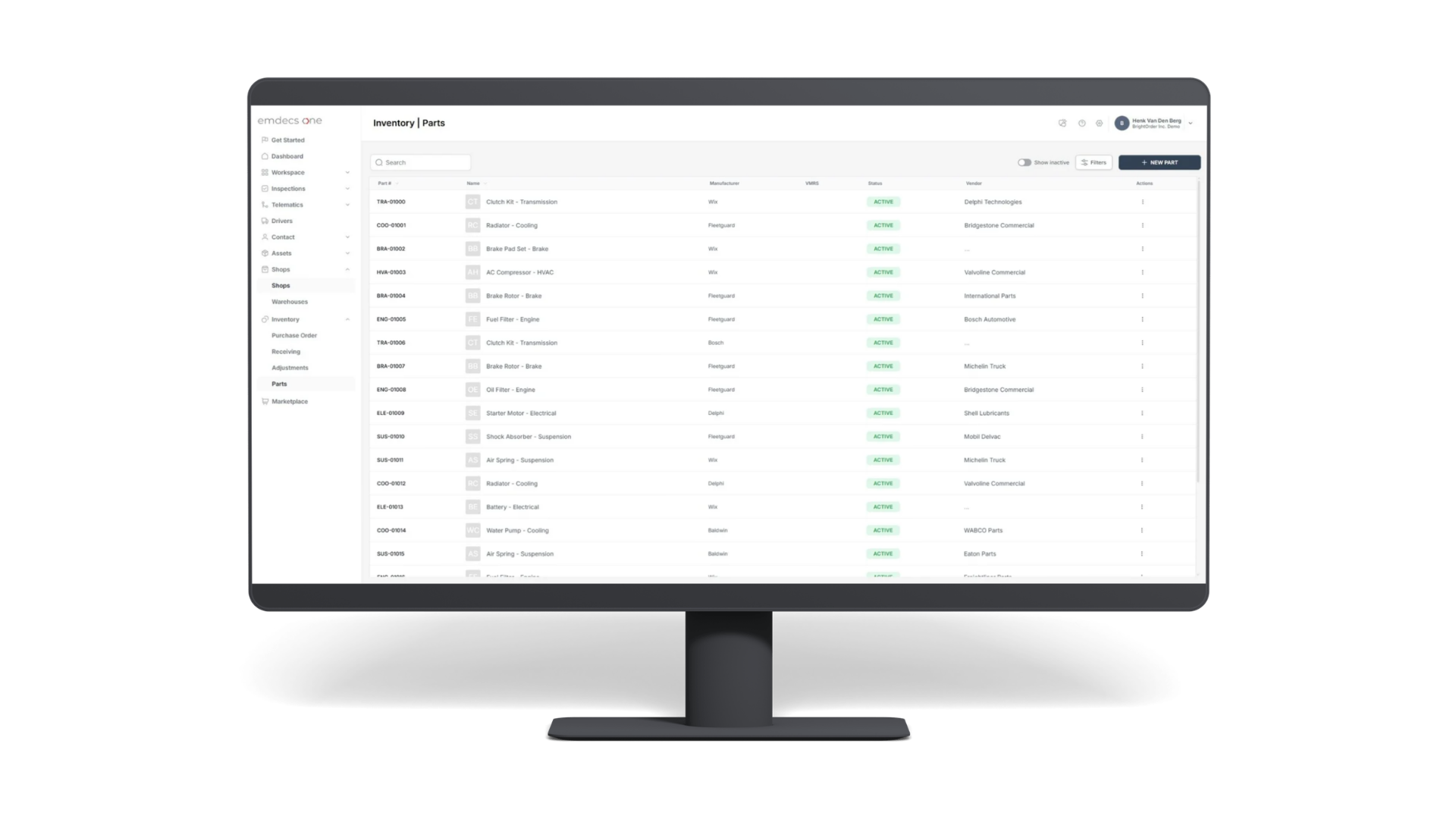
Stock levels tracked across every warehouse and parts room down to the aisle and bin. Reorder suggestions built from usage history so the shelf is stocked before someone finds out it is not.
Multi-location inventory in one view. Every warehouse, every parts room, one system.
Suggested reorders based on what you actually use
Barcode-ready receiving matched against purchase orders
Labour, parts, surcharges, and VAT calculated on the RO
carry straight through to billing.
Costs and parts already attached. Nothing re-entered.
Summarised invoices sent to your accounting tools automatically.
Customers review, approve, and receive invoices on their own.
Work above a set amount gets reviewed before billing goes out.
Which units cost the most to maintain?
How many PMs need attention today?
Are driver-reported defects trending?
Ask in plain English. emdecs one answers from your own data.
It manages the full maintenance workflow in one system: work orders, preventative maintenance schedules, safety inspections, parts and inventory, and invoicing. Technicians log work from the workshop or the field, and records, costs, and roadworthiness history stay attached to every unit automatically.
Yes. Technicians open work orders, log time, add parts, complete inspection forms, and close jobs from a phone or tablet, wherever the work is happening. Nothing waits for someone to get back to a desk.
Each unit follows its own schedule based on mileage, engine hours, or calendar intervals. Automated reminders surface upcoming and overdue PMs, so inspections and services are planned rather than chased.
Yes. Workshops that service other operators' fleets use the same system: work orders feed customer estimates, approvals, and invoices, with a customer portal for review and sign-off.
Yes. Ask in plain English, like which units cost the most to maintain or how many PMs need attention today, and emdecs one answers from your operation's own data.
years in workshop management and fleet maintenance
Support based in the UK
emdecs one comes from nearly three decades of building for workshops and fleets that run on tight margins and tighter schedules.
The platform was shaped by the workflows of real maintenance operations, not assumptions about how they should work.